
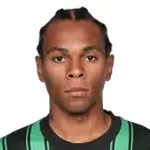
Armand Laurienté is not Sassuolo's most prolific scorer, but he is the player who most consistently converts possession into danger — and in Fabio Grosso's system, that distinction matters more than the goal tally suggests.
Grosso's Sassuolo sit tenth in Serie A with 45 points from 33 matches, a record of 13 wins, six draws and 14 defeats that places them comfortably mid-table but exposes a side that concedes marginally more than it scores: 44 goals against, 41 for. In that context, a forward who generates rather than merely finishes is structurally valuable. Laurienté, 27, has contributed five goals and eight assists this season — thirteen direct goal involvements in a team that has scored 41 times means he has had a hand in roughly one in three of Sassuolo's goals. That ratio is the foundation of his tactical importance.
Grosso tends to build in a shape that asks wide forwards to combine positional intelligence with vertical threat. Laurienté operates in that mould: he is not a fixed winger who hugs the touchline, nor a pure second striker, but a player who drifts between the half-spaces and the flank depending on where the defensive line is most exposed. His eight assists indicate a player who reads the final third as a distributor first, arriving at the moment a teammate needs the ball rather than demanding it for himself. That is a specific and trainable quality, and Grosso's system appears built, at least in part, around exploiting it.
His zones of influence are most pronounced in the left channel and the area just outside the opposition penalty box. From those positions he can cut inside onto his stronger foot or play the early cross before the defensive shape recovers. The five goals suggest he is not shy of the shot, but the superior assist count points to a player whose decision-making defaults toward the pass when the numbers are right. An average match rating of 6.90 across the season is consistent rather than spectacular — the mark of someone who contributes without dominating, which is precisely what a mid-table side in transition needs from a wide forward.
Against deep defensive blocks, Laurienté's profile creates genuine problems. His movement between lines forces defenders to choose between tracking a runner and holding their shape, and his willingness to combine in tight spaces means he does not become passive when space is compressed. The eight assists are largely a product of that adaptability. Where he is more vulnerable is against high-pressing sides with disciplined wide midfielders who can pin him back and deny him the half-second he needs to pick his pass. Sassuolo's 14 defeats this season suggest the team as a whole struggles against that kind of organised aggression, and Laurienté is not immune to those structural problems.
The AI assessment places him at 67 out of 100 overall, with a ceiling of 72 — numbers that describe a reliable Serie A contributor rather than a player pushing toward the elite tier. That gap between current and potential is instructive: there is room for development, but it is measured, not speculative. At 27, Laurienté is in the phase of his career where tactical refinement matters more than raw improvement. His technical scores support the picture painted by the assist data — a player with the touch and vision to operate in congested areas, but one whose physical profile does not allow him to simply overpower opponents when the technical route is closed. The mental and tactical components of his score reflect the consistency his rating confirms: he makes the right decision often enough to be trusted in key moments, without yet being the player a coach designs an entire attacking system around.
Laurienté is the connective tissue of Grosso's attack — not the finisher, not the creator in the deep-lying sense, but the player who joins the two functions at the point where matches are decided. For a Sassuolo side that scores too infrequently to carry passengers in the final third, his thirteen direct involvements in 33 matches make him the most tactically indispensable forward on the pitch.