
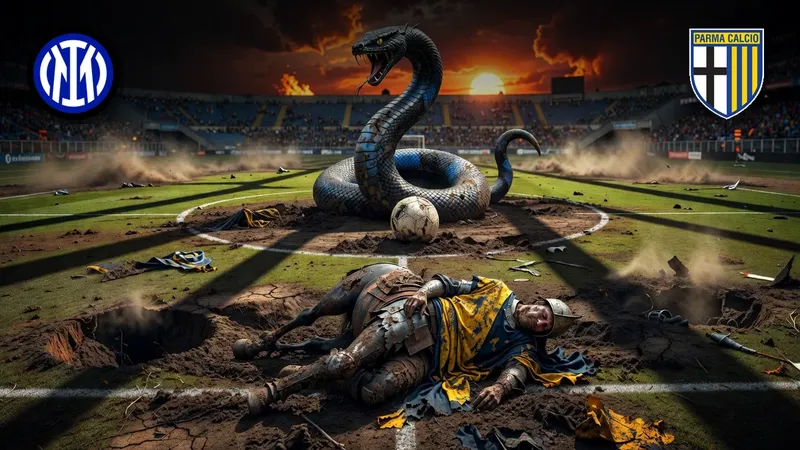
Inter secured a 2-0 home victory against Parma, a result largely shaped by two pivotal moments. A goal in first-half stoppage time forced Parma coach Carlos Cuesta García into an early tactical rethink, while a second strike midway through the second period came directly from the substitutes Cristian Chivu had introduced to close out the contest.
Inter midfielder Piotr Zielinski threaded the decisive pass that sent Inter forward Marcus Thuram clean through in the 45th minute, and the Frenchman calmly converted to give the Nerazzurri the lead at the interval. The timing of the goal was crucial. Parma had largely held their defensive shape for the majority of the first half, but conceding in added time denied Cuesta García any chance to react before the break. His response came immediately after the restart, but the psychological blow had already been struck. Parma were now forced to chase the game against a side that had netted sixteen goals across their last five fixtures.
The second goal, however, came from a completely different Inter. In the 67th minute, Inter coach Cristian Chivu made three simultaneous substitutions: Carlos Augusto replaced Alessandro Bastoni, Henrikh Mkhitaryan came on for Zielinski – who had been cautioned three minutes prior – and Lautaro Martínez took the place of Thuram. Thirteen minutes later, Lautaro turned provider, and Mkhitaryan clinically finished to double Inter's advantage. This sequence perfectly illustrated Chivu's squad management philosophy: the starting XI opens the game, the bench closes it. The 80th-minute goal wasn't a result of Parma's high press or Inter soaking up pressure; it was the direct outcome of a planned wave of substitutions arriving with a specific purpose, which was executed to perfection.
Mkhitaryan's goal was the one that ultimately sealed the result, and its context bears closer examination. Brought on as a replacement for a midfielder who had just received a yellow card, the Armenian international entered a game that was already firmly in Inter's favour and simply required astute management. His clinical finish, assisted by Lautaro, converted that management into a mathematical certainty. For a side that has amassed thirteen points from their last five matches, the ability to find goals from a second wave of substitutes – not just the initial starters – underscores a squad depth that rival teams simply cannot replicate.
Parma's evening was certainly not for want of effort, but their attacking output remained limited throughout. The visitors arrived at San Siro having won two of their last five matches and drawn two others, a run that spoke more of defensive resilience than offensive ambition. Their starting front line of Strefezza and Pellegrino found no joy against an Inter defensive structure expertly anchored by Bastoni and Akanji, with neither attacker still on the pitch by the 75th minute. Cuesta García's subsequent substitutions, including the introductions of Pontus Almqvist and Oliver Sørensen in the 75th minute, failed to provide the visitors with the necessary attacking foothold. Parma ultimately finished the match without finding the net, without picking up a yellow card, and crucially, without a single moment that genuinely troubled Yann Sommer's goal.
Inter's recent form – four wins, one draw, sixteen goals scored, and seven conceded across their last five matches – places this result within a consistent pattern, rather than as an isolated performance. The draw at Torino on April 26th remains the sole blemish in that period, and even that was an away fixture. At San Siro, Chivu's men have been particularly formidable: the 3-0 thrashing of Cagliari and the 5-2 demolition of Roma in April established a potent home rhythm that this Parma outfit simply had no realistic means of disrupting. While the last three matches paint a slightly tighter picture – two wins, one draw, seven goals scored, two conceded – the overall trajectory remains unequivocally positive.
A month from now, this match will likely be remembered not for any dramatic twists, but for Inter's clinical efficiency: one moment of genuine quality just before half-time, followed by a perfectly timed wave of substitutions, proved all Chivu's side needed. Parma, on the other hand, never truly found an answer to either.